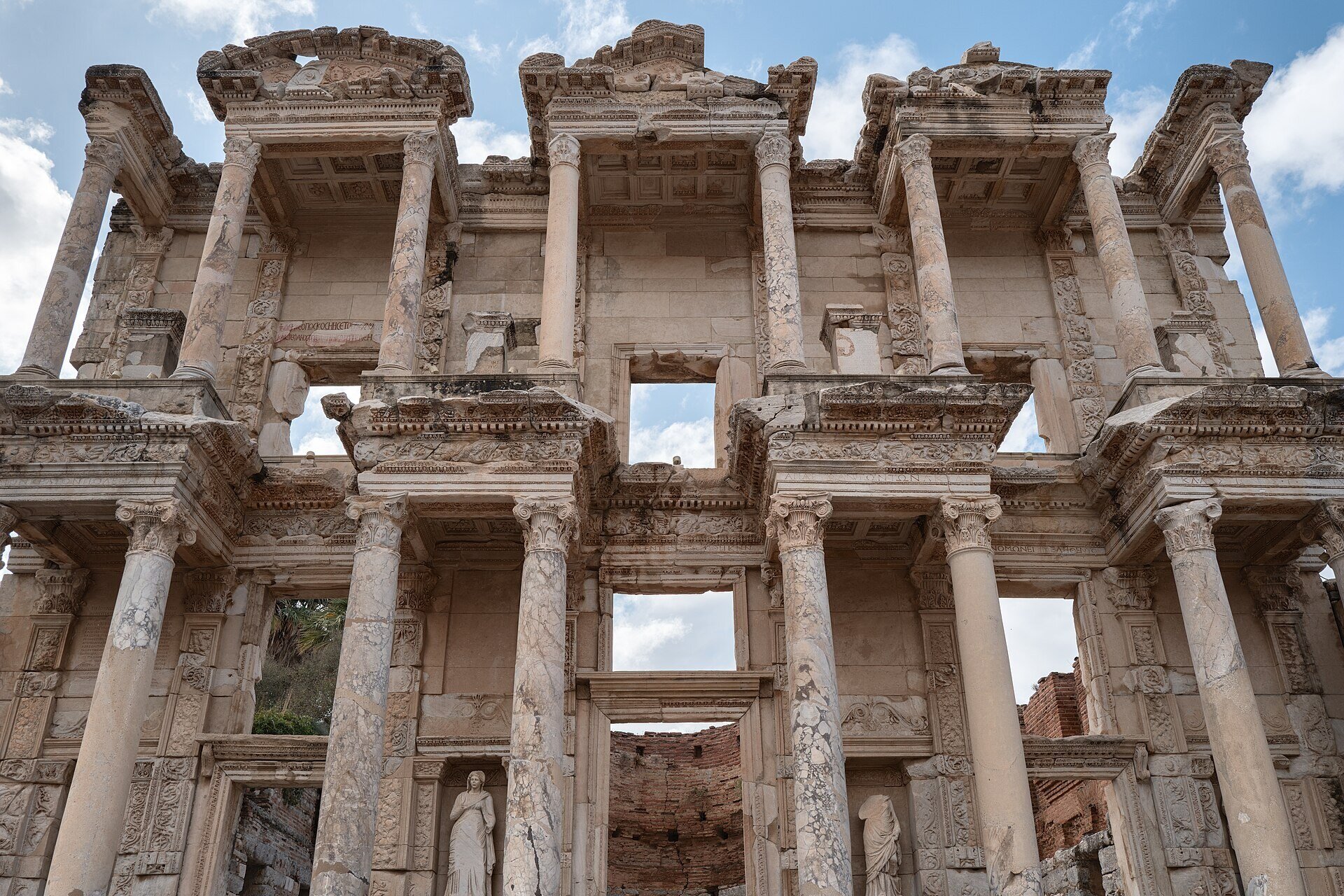
The Celsus Library stands at the heart of the Ephesus Archaeological Site in Selcuk, positioned at the angle where the sloped Curetes Street meets the flat Marble Road. Whether you enter the ruins through the Upper Gate (Magnesia Gate) or the Lower Gate (Harbor Gate), the main footpath leads straight into the paved courtyard in front of the library facade. Visitors reach Selcuk by train or car from Izmir Adnan Menderes Airport, or by taxi and tour bus from the Kusadasi cruise port. The monument is open daily as part of the UNESCO-listed archaeological park, and visitors can climb the front porch steps and enter the ground-level reading room interior.
Plan to pause in the courtyard to examine the lower niches, carved door frames, and interior brickwork. Because the facade faces east, early morning sunlight illuminates the two-story marble columns directly, while late afternoon and seasonal Night Museum openings let you view the structure with fewer tour groups and cooler air. Entry is covered by the general 40 euro daytime Ephesus ticket, and both Museum Pass Turkiye and the Museum Pass Aegean are accepted during regular daytime hours. Check the official site before you go for current hours and prices.
Commissioned by the Roman consul Tiberius Julius Aquila and completed around 135 AD during the reign of Emperor Hadrian, the building honored Aquila's father, Tiberius Julius Celsus Polemaeanus, who had served as Roman Consul in 92 AD and Governor of the Roman Province of Asia in 115 AD. Surpassed in size only by the libraries of Alexandria and Pergamum in the Greco-Roman world, its interior perished in a fire in 262 AD, and Austrian researchers led by Volker Michael Strocka and Friedmund Hueber re-erected the fallen facade between 1970 and 1978 using the anastylosis method.
Because the Celsus Library sits at the main intersection inside ancient Ephesus, you can step directly from its courtyard into the surrounding Roman streets and pair your visit with other stops in Selcuk.
| Place | Type | Time needed | Best for | Entry |
|---|---|---|---|---|
| The Celsus Library | Roman library and tomb | n/a | Reconstructed two-story marble facade and four virtue statues | Ticket |
| The Great Theatre of Ephesus | Ancient open-air theater | n/a | Climbing the 25,000-seat cavea and viewing Harbor Street | Ticket |
| The Ephesus Agora | Roman commercial agora | n/a | Exploring the ancient market square beside the library | Ticket |
| Ephesus Museum | Indoor archaeological museum | n/a | Viewing original Ephesian sculptures in Selcuk town | Ticket |
The four female statues standing in the lower niches of the Celsus Library today are high-accuracy copies placed there during the 1970 to 1978 reconstruction. Austrian archaeologists uncovered the original marble statues of Sophia, Arete, Ennoia, and Episteme during excavations in 1903 and 1904, and those originals are displayed at the Ephesos Museum in Vienna. However, the carved columns, capitals, and entablatures of the reconstructed facade incorporate the original ancient marble blocks found on site.
Yes, visitors can walk up the wide marble steps, pass through the three doorway openings of the facade, and stand inside the unroofed reading room. From the interior floor, you can see the brick wall niches that once held wooden cabinets for around 12,000 scrolls, as well as the central semicircular apse. The lower subterranean crypt holding Celsus's marble sarcophagus is generally closed to regular foot traffic.
Because the facade of the Celsus Library faces east, morning sunlight shines directly onto the marble columns and statues. Arriving as soon as the gates of Ephesus open in the morning also lets you reach the courtyard before large cruise ship groups gather on the steps. Another option is to visit during the seasonal Night Museum hours when warm spotlights illuminate the two-story stonework against the dark sky.
Yes, the Celsus Library is the central landmark along the main walking route inside the Ephesus Archaeological Site and requires no extra fee beyond the park entrance ticket. Daytime admission to Ephesus is 40 euros for foreign visitors, and both Museum Pass Turkiye and the Museum Pass Aegean are accepted at the turnstiles. Only the covered Terrace Houses across the street from the library require an additional ticket.
Roman engineers built the 180-square-meter reading room over a raised vaulted substructure so ground moisture could not seep up into the floor. They also constructed a narrow empty corridor between the inner brick wall holding the scroll niches and the outer wall of the building. This double-wall design circulated air and buffered the papyrus manuscripts against extreme heat and humidity until a fire destroyed the interior in 262 AD.
In the Roman Empire, burial inside a city's sacred boundary was normally prohibited by law and reserved only for recognized heroes or city founders. Because Tiberius Julius Celsus Polemaeanus had served as a Roman Consul and as a respected Governor of the Province of Asia, the city of Ephesus granted his son Tiberius Julius Aquila permission to build the library as a monumental hero-tomb. Celsus's marble sarcophagus was placed in a vaulted burial chamber directly beneath the main apse.
Sources: en.wikipedia.org, whc.unesco.org, muze.gov.tr
Last reviewed: