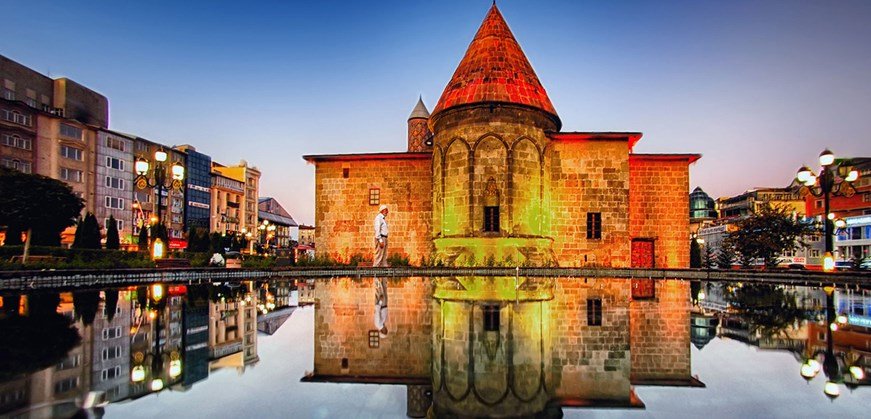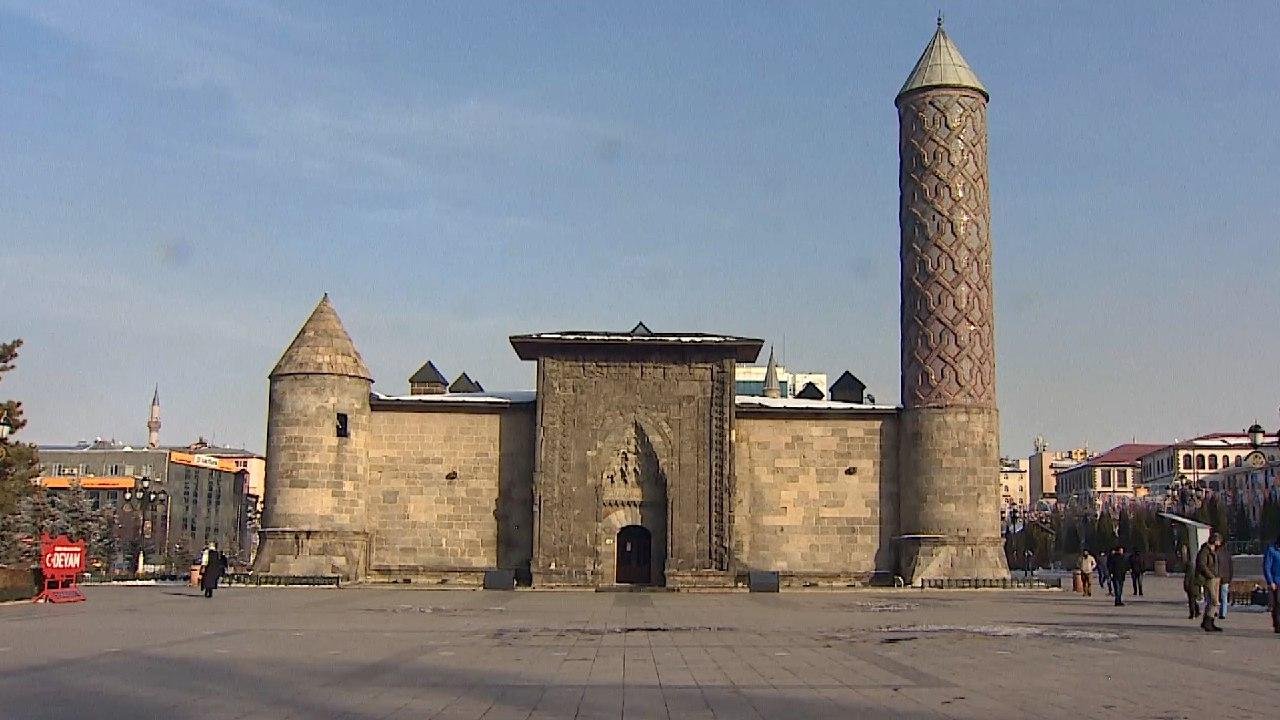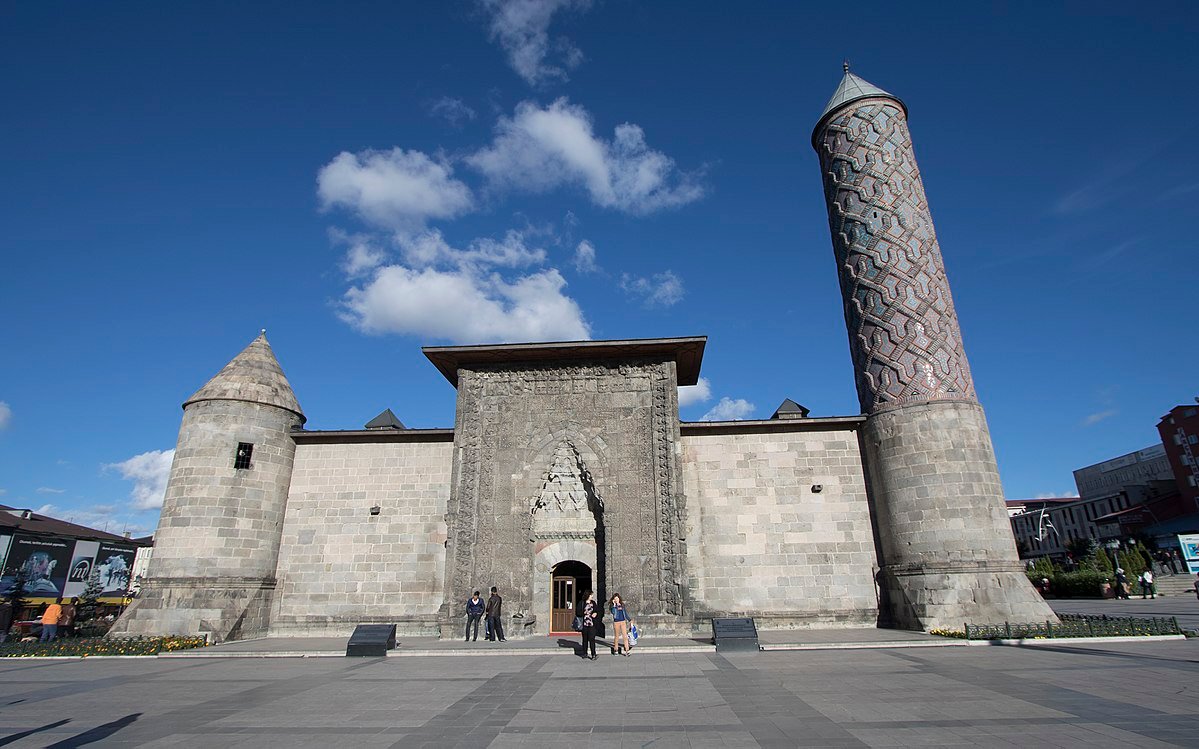
Yakutiye Madrasa Erzurum stands directly on Cumhuriyet Street in the central Yakutiye district, right beside the Ottoman-era Lala Pasha Mosque. Travelers arriving at Erzurum Airport can take a municipal airport shuttle or a taxi straight into the city center, where the monument sits on a flat pedestrian plaza within a few minutes on foot of the main municipal bus stops. Because the building operates under the Ministry of Culture and Tourism as the Turkish and Islamic Arts and Ethnography Museum, an entry ticket is required and Museum Pass Turkiye is accepted at the gate. Check the official site before you go for current hours and prices.
The structure is open to visitors and in sound condition following state restoration work, though winter blizzards and subzero temperatures in eastern Anatolia can make the entrance steps icy. Most travelers spend under an hour walking through the vaulted courtyard and the side display rooms. Late spring through early autumn brings comfortable daytime weather for exploring downtown Erzurum on foot. Morning visits give you even daylight on the west-facing stone portal before afternoon pedestrian traffic fills the surrounding square.
Completed in 1310 with endowment revenues dedicated to Ilkhanid ruler Ghazan Khan and Bolugan Khatun, the building later served as an Ottoman cannon foundry and military warehouse before opening in 1994 as a state museum. In 2014, UNESCO added the monument to its World Heritage Tentative List under the Anatolian Seljuk Madrasahs group. As you examine the exterior and interior halls, look for these specific features:
Because Erzurum's medieval monuments sit close together in the downtown core, you can build a half-day walking route directly from the museum doors. Start by walking east along Cumhuriyet Street to The Double Minareted Madrasa of Erzurum, which lets you compare Yakutiye's enclosed winter vault with an open two-story courtyard plan from the same period. Right across the street rises Erzurum Castle, where you can climb the ramparts and the brick clock tower to look down over the stone roofs of the old quarter.
If you want to balance urban history with high mountain air in the afternoon, take a short drive south of the city center to Palandoken Ski Resort for cable car views or winter skiing. Travelers following a wider overland route across eastern Anatolia can also continue west to the city of Sivas to visit The Double Minaret Madrasa, whose carved stone facade shares direct architectural roots with Erzurum's medieval schools.
| Place | Type | Time needed | Best for | Entry |
|---|---|---|---|---|
| Yakutiye Madrasa | Single-story enclosed madrasa and museum | n/a | 1310 stone portal reliefs and ethnography exhibits | Ticket |
| The Double Minareted Madrasa of Erzurum | Two-story open-courtyard madrasa | n/a | Twin tiled minarets and conical mausoleum | n/a |
| Erzurum Castle | Historic hilltop citadel | n/a | Panoramic city views and medieval ramparts | Ticket |
| Tortum Waterfall | Natural waterfall in Uzundere | n/a | Valley scenery and outdoor photography | Free |
Yes, it is one of the best-preserved Ilkhanid and Seljuk-era monuments in eastern Anatolia. Its carved stone portal combines Islamic geometric patterns with Central Asian animal reliefs that are rare on religious buildings. Inside, the vaulted rooms hold an ethnography collection that explains daily life and craftsmanship in the Erzurum highlands.
Most visitors need about forty-five minutes to an hour to see the entire site. That gives you enough time to study the exterior stone carvings on the main gate and walk through the small student rooms around the covered courtyard. If you read every display label in the ethnography rooms, plan for slightly over an hour.
Yes, because the building functions as the Turkish and Islamic Arts and Ethnography Museum under the Ministry of Culture and Tourism, Museum Pass Turkiye is accepted. Visitors without a pass can buy an individual entry ticket at the booth by the front gate. Check the official museum portal before your visit for current ticket prices and seasonal opening hours.
You can take the municipal airport shuttle bus or a taxi from Erzurum Airport directly into the city center. The monument sits on Cumhuriyet Street next to Lala Pasha Mosque, which is the main landmark in the downtown Yakutiye district. Once you are in the historic center, you can reach the entrance easily on foot.
Late spring, summer, and early autumn offer the most comfortable temperatures for walking around Erzurum's historic center. Because the courtyard is fully roofed, the museum is also practical to visit during winter ski trips, though outdoor steps can be snowy. Morning hours provide the best natural light on the western entrance portal.
The building has a single-story floor plan, which avoids the steep upper-gallery stairs found in two-story medieval schools. However, the historic stone threshold and narrow original doorways between the vaulted student cells require stepping over raised stone sills. Families with children find the compact layout and weapons, jewelry, and costume displays easy to explore.
Sources: en.wikipedia.org, whc.unesco.org, muze.gov.tr, kulturportali.gov.tr
Last reviewed: