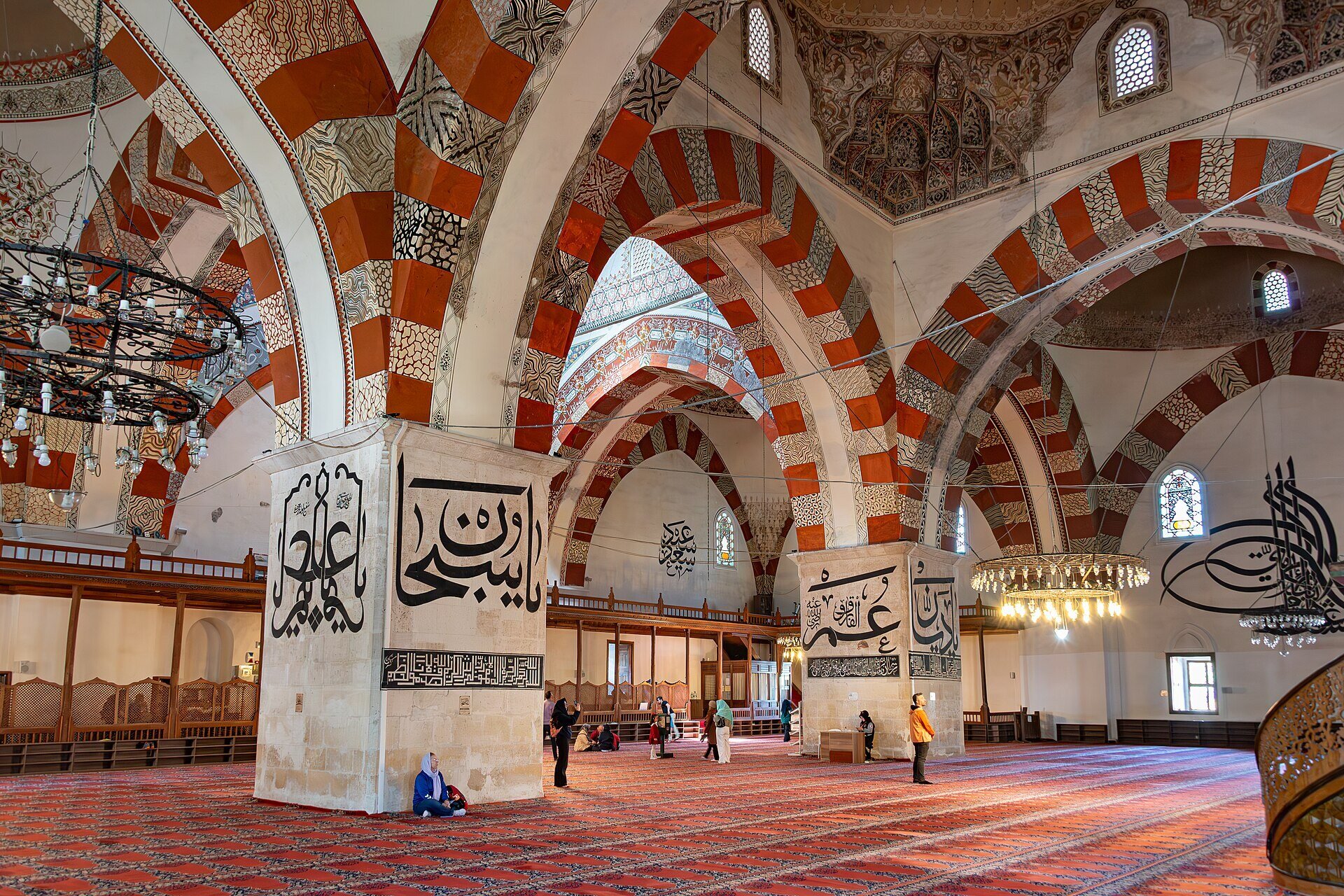
The Old Mosque of Edirne

The Old Mosque of Edirne: A Historic Gem

Introduction

The Old Mosque of Edirne, located in the heart of the city, is one of the oldest and most distinctive monumental structures in Turkey. This magnificent building, bearing the marks of time, is considered one of the earliest examples of Ottoman architecture. With its historical significance and architectural features, the Old Mosque captivates visitors and is well worth seeing for those traveling to Edirne.

Construction and History
Construction of the Old Mosque began in 1403 under the patronage of Emir Süleyman, son of Bayezid I. After his death, however, construction was halted, and the mosque was completed in 1414 by Çelebi Mehmed. According to the inscription on the side door, the architect was Konyalı Hacı Alâeddin and his foreman was İbrahim son of Ömer.

Distinguished by its nine-dome system and spacious interior, the mosque is the first original monumental structure to survive in Edirne. The whitewashed walls and the various inscriptions from the 18th and 20th centuries on the columns reflect the mosque’s importance throughout history and the restoration processes it underwent.

Significance
The Old Mosque holds great significance not only for Edirne but also for Ottoman architecture. As one of the earliest examples of Ottoman mosques, it represents the architectural understanding of the period. Moreover, it served as a significant center of social and cultural life in Edirne during the Ottoman era.

The mosque continues to play a vital role in the religious life of Edirne, serving as a place of worship for the people of the city.

Places to Visit
Visitors to the Old Mosque can explore not only the interior of the mosque but also the surrounding historical structures.

Main Chamber: The spacious and bright interior impresses visitors with its nine domes and ornate mihrab.
Minaret: Located on the western corner of the mosque, the minaret features two balconies.
Wall Inscriptions: The various inscriptions on the walls of the mosque are fine examples of calligraphy from the period.
Courtyard: The mosque courtyard is a peaceful place for rest and prayer.

Current State
The Old Mosque has undergone several restorations over the years, including recent ones. It is a significant tourist attraction for both domestic and foreign visitors to Edirne, reflecting the city’s rich history and culture.

Conclusion
The Old Mosque of Edirne is not merely a place of worship but also a work of art, a historical legacy, and a cultural center. As one of the earliest examples of Ottoman architecture, the mosque gives visitors fine architecture to admire and a chance to journey through the city’s history. It is well worth a visit for anyone traveling to Edirne.


Visiting The Old Mosque of Edirne: practical information

Known in Turkish as Eski Cami or Ulu Cami, the mosque stands directly at the main pedestrian crossroads in central Edirne. Visitors arriving at the Edirne bus terminal or train station can reach the historic core by local minibus or taxi, while international travelers usually fly into Istanbul Airport and travel west by highway coach or private car. The building is open daily as an active neighborhood and Friday congregation mosque, and its structure remains in good condition following restoration work. Doors close briefly to sightseeing visitors during the five daily prayer times and for a longer period around Friday midday prayers.

Plan enough time to examine the monumental wall calligraphy, the sacred stone near the mihrab, and the outer portico. Late morning or mid-afternoon between prayers provides bright natural light across the whitewashed piers. Spring and autumn offer comfortable weather for walking between Edirne's downtown monuments. Entry to the mosque is free, and neither a ticket nor Museum Pass Turkiye is required. Visitors should wear modest clothing that covers shoulders and knees, women should cover their hair with the scarves available at the entrance, and everyone must remove shoes before stepping onto the prayer carpets.

History and what to see

Started in 1403 by Emir Suleyman during the Ottoman Interregnum and completed in 1414 under his brother Sultan Mehmed I by architect Konyali Haci Alaeddin and master builder Ibrahim son of Omer, this is Edirne's oldest surviving monumental Ottoman building. In later centuries, Ottoman sultans including Ahmed II and Mustafa II held their ceremonial sword-girding rites here, a tradition still recalled when the imam mounts the Friday pulpit carrying a sword.

  • Monumental Mural Calligraphy: Bold 18th- and 19th-century black calligraphic panels painted across the whitewashed walls and piers, including inscriptions added under Sultan Abdulhamid II.
  • Rukn-u Yemani (Kaaba Stone): A revered black stone fragment brought from the Kaaba in Mecca, embedded in the wall to the right of the mihrab beside a small niche.
  • Haci Bayram Veli Preacher's Pulpit: The historic wooden platform where the Sufi scholar Haci Bayram Veli preached during the reign of Sultan Murad II; out of respect, imams leave this pulpit unused today.
  • Nine-Dome Hall and Twin Minarets: Four massive square piers carry nine domes inside, while the exterior pairs an early single-balcony minaret with a taller two-balcony minaret added by Murad II.

Nearby places to combine

Sitting at the center of Edirne's walkable historic district, the mosque connects effortlessly with surrounding Ottoman and cultural landmarks:

  • Ali Pasa Bazaar begins just steps away across the main street, making it the easiest next stop to browse local almond paste, fruit soaps, and textiles beneath a 16th-century vaulted roof.
  • The Selimiye Mosque rises a few minutes on foot uphill, offering a direct architectural comparison between this early 1414 nine-dome hall and Mimar Sinan's 1575 single-dome imperial sanctuary.
  • Edirne Great Synagogue lies a short walk west in the Kaleici neighborhood and adds an important look at the city's Jewish community to your walking route.
  • The II. Bayezid Complex and The Edirne Darussifa sit a short taxi ride across the Tunca River, where you can explore a 15th-century Ottoman hospital and medical school.

Comparing The Old Mosque of Edirne with nearby landmarks

PlaceTypeTime neededBest forEntry
The Old Mosque of EdirneEarly Ottoman mosquen/a1414 nine-dome hall, giant calligraphy, and Kaaba stoneFree
The Selimiye MosqueUNESCO imperial mosquen/aMimar Sinan's 1575 central dome and four minaretsFree
Ali Pasa BazaarHistoric covered bazaarn/aTraditional shopping and 16th-century market archesFree
Edirne Great SynagogueHistoric synagoguen/aJewish heritage in the Kaleici neighborhoodn/a
The II. Bayezid ComplexOttoman complex and museumn/aOttoman hospital museum on the Tunca RiverTicket

Frequently asked questions

Is The Old Mosque of Edirne worth visiting?

Yes, as the oldest surviving monumental Ottoman building in Edirne, its early multi-domed interior feels very different from later imperial mosques. Visitors come specifically to see the giant black calligraphic inscriptions on its whitewashed piers and the sacred Kaaba stone fragment near the mihrab.

How long does a visit to The Old Mosque of Edirne take?

Most travelers spend a short, focused visit walking through the nine-domed prayer hall, admiring the wall calligraphy, and viewing the exterior portico. Because it sits right in the pedestrian center, it fits easily into a morning or afternoon walking route.

Is there an entrance fee for The Old Mosque of Edirne?

No, admission to The Old Mosque of Edirne is completely free and no ticket or Museum Pass Turkiye is needed. Modest dress is required, and shoes must be removed at the entrance before stepping onto the carpets.

When is the best time of day to visit The Old Mosque of Edirne?

Late morning or mid-afternoon between the five daily Islamic prayer times is best so you can walk around the interior without interrupting worshippers. Avoid Friday midday, when the hall fills for the weekly congregation prayer.

How do I get to The Old Mosque of Edirne?

The mosque stands right at the central pedestrian intersection of downtown Edirne, immediately across from the Covered Bazaar (Bedesten) and a short walk from Ali Pasa Bazaar. From the Edirne bus station, local minibuses and taxis drop you right at the edge of the pedestrian zone.

What can I combine with a visit to The Old Mosque of Edirne?

You can walk uphill in a few minutes to The Selimiye Mosque or cross the street to shop inside Ali Pasa Bazaar. Walking west into the Kaleici district also brings you to the restored Edirne Great Synagogue.

Sources: en.wikipedia.org, edirne.gov.tr

Last reviewed:

Tours that visit Edirne

The Old Mosque of Edirne.md