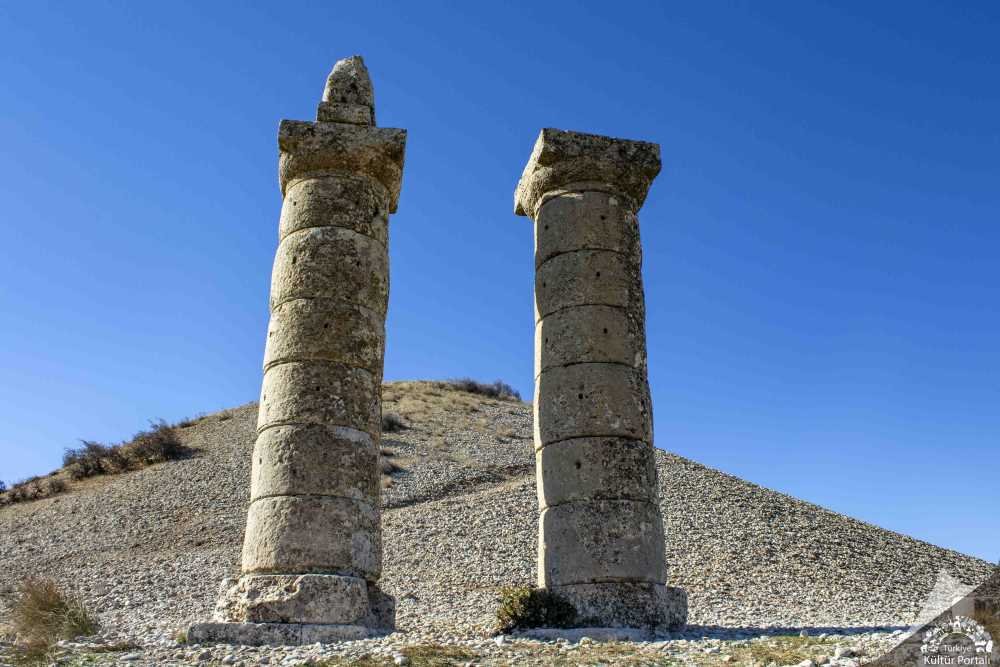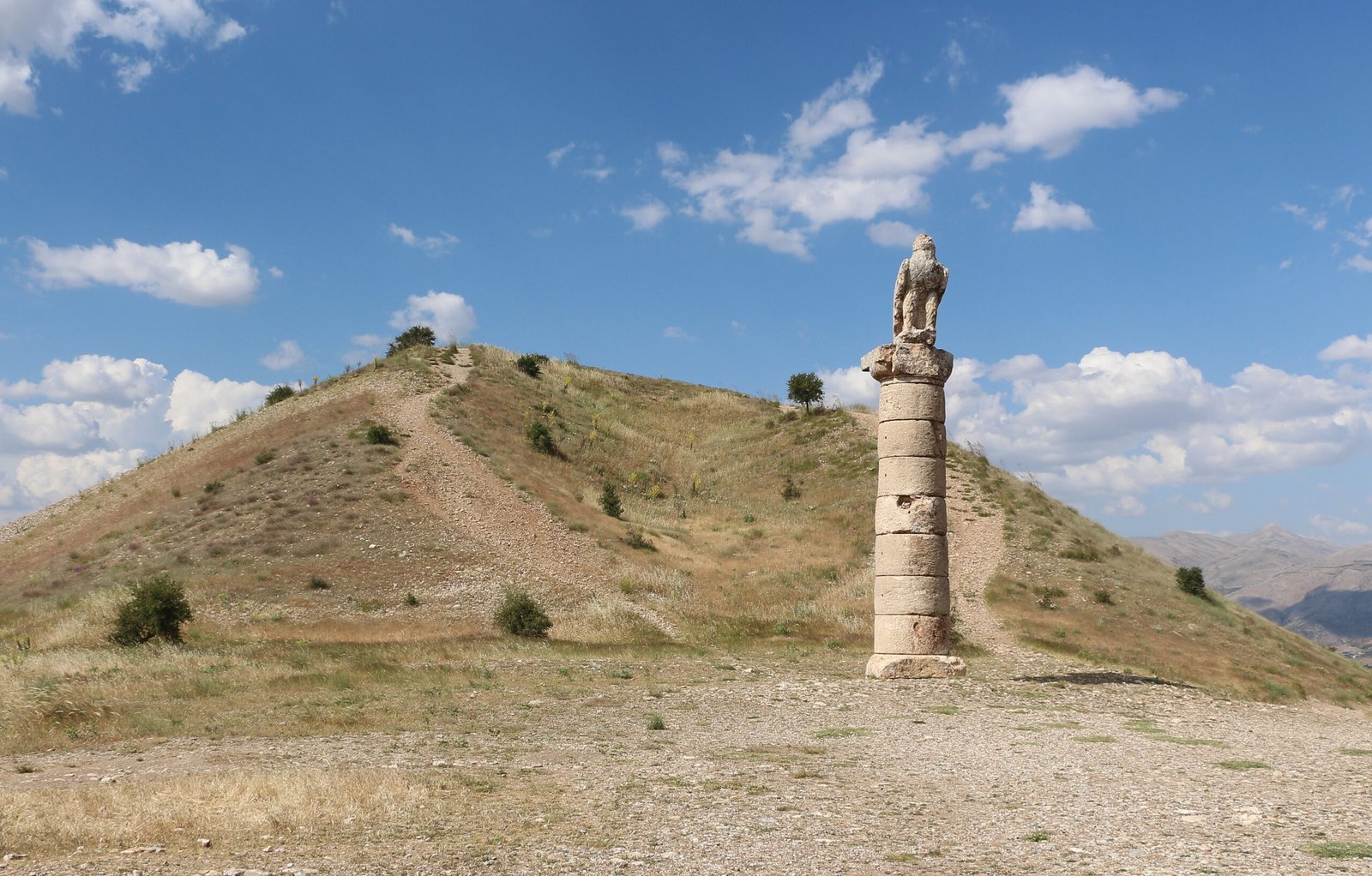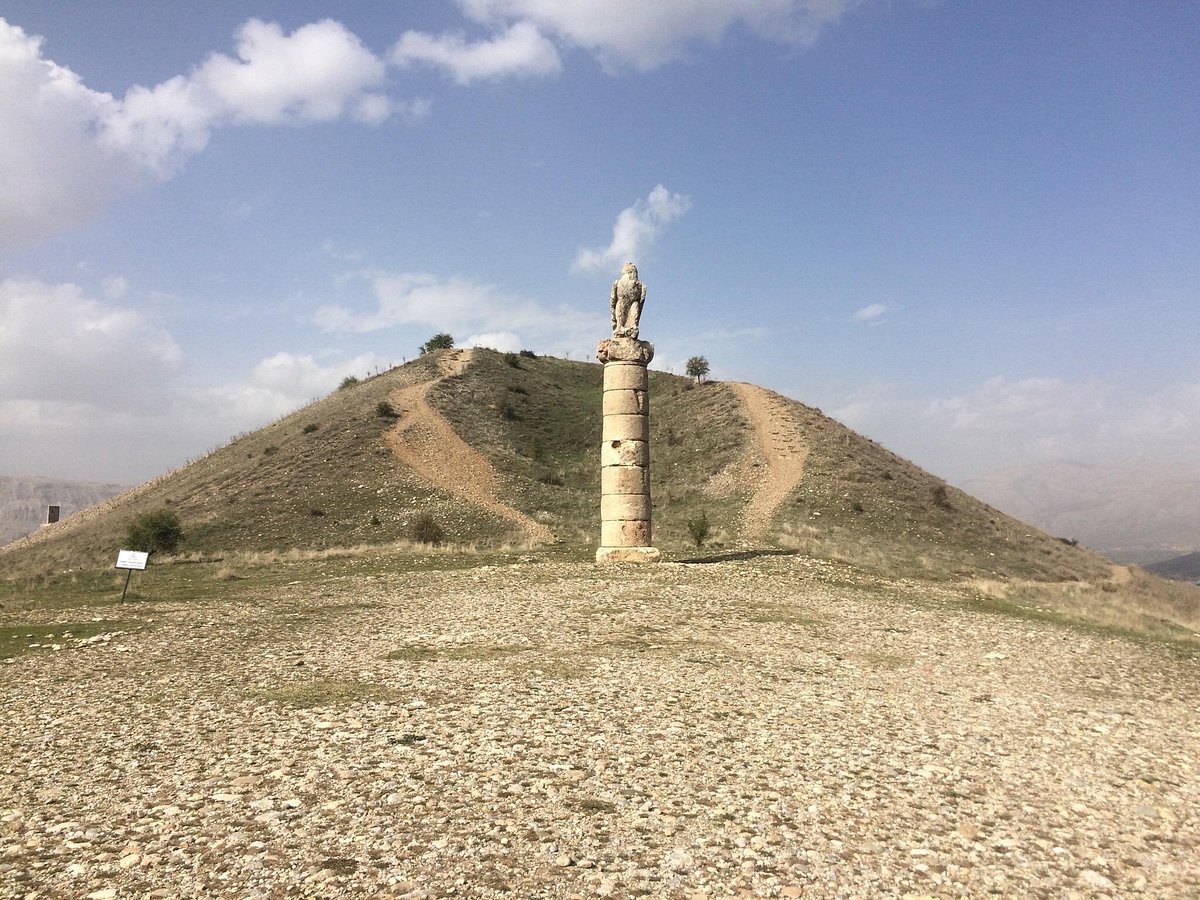
Current status: During the February 6, 2023 earthquakes, the northwestern column of the Karakus Tumulus collapsed, damaging its handshake relief. Ministry of Culture and Tourism teams subsequently conserved the stone fragments and re-erected the column, and the site is open to visitors year-round. Because it is an open-air monument directly beside the road with no ticket booth, entry is free and no Museum Pass Turkiye is needed.
The tumulus stands in the Kahta district at the southern entrance to Mount Nemrut National Park, right along the paved road leading from Kahta toward Cendere Bridge and Mount Nemrut. There is no scheduled public bus service along this tourist corridor, so visitors arrive by rental car, taxi, or guided tour from Kahta or central Adıyaman. A paved parking area sits immediately next to the mound, and flat stone paths circle the base, making this the most accessible Commagene monument in the region for families and travelers with limited mobility. Plan for 20 to 30 minutes here. On clear mornings and late afternoons, you can see the summit of Mount Nemrut in the distance.
Constructed between roughly 30 and 20 BC by King Mithridates II of Commagene, this hierothesion served as the monumental burial site for the royal women of his dynasty: his mother Queen Isias Philostorgos, his sisters Antiochis and Laodice, and his niece Aka I. In the late 2nd century AD, soldiers of the 16th Roman Legion quarried many of the dressed stones from the site to build the nearby Cendere Bridge and looted the underground burial vault.
Karakus Tumulus is the first stop on the standard route into Mount Nemrut National Park from Kahta, so almost every visitor combines it with the neighboring valley monuments. Continuing north along the same road brings you to Cendere Bridge, the Roman single-arch bridge built between AD 198 and 200 using stone blocks taken in part from the tumulus complex itself.
From the bridge, the road climbs toward Kocahisar village, where Kahta and Kahta Castle faces Arsameia Ancient City across the Kahta River canyon. After exploring the Mamluk fortress and the Commagene reliefs at Arsameia, continue up the mountain road to Mount Nemrut to watch sunrise or sunset beside the colossal stone heads of King Antiochos I's sanctuary. If you are driving out from central Adıyaman, you can also stop at Perre Ancient City before heading east to Kahta.
| Place | Type | Time needed | Best for | Entry |
|---|---|---|---|---|
| Karakus Tumulus | Royal women's burial mound | 20-30 mins | Eagle column and easy flat walk | Free |
| Cendere Bridge | Roman stone arch bridge | 20-30 mins | Intact Roman engineering built with local stone | Free |
| Arsameia Ancient City | Commagene summer capital | 45-60 mins | Heracles handshake stele and rock tunnel | Free |
| Mount Nemrut | Royal tomb sanctuary of Antiochos I | 2-3 hours | Giant stone heads at 2,150 meters | Ticket |
Yes, the northwestern column bearing the handshake relief of King Mithridates II and his sister Laodice collapsed during the February 6, 2023 earthquakes. Specialists from the Ministry of Culture and Tourism repaired and re-erected the column and stele, and the site is open to visitors.
King Mithridates II built the monument between roughly 30 and 20 BC as a royal tomb for the women of the Commagene dynasty. Greek inscriptions and reliefs identify his mother Queen Isias Philostorgos, his sisters Antiochis and Laodice, and Antiochis's daughter Aka I.
Karakuş means Black Bird in Turkish. Local residents named the hilltop after the large limestone statue of an eagle perched atop the southern column.
A visit takes 20 to 30 minutes. That gives you enough time to walk the circular path around the pebble mound, examine the four remaining columns from the south, northeast, and northwest sides, and take photos of the surrounding hills.
No, Karakus Tumulus is an open-air site with no gate or ticket office. It is free to enter at any time of day, and you do not need a Museum Pass.
Yes, unlike the steep climbs at Mount Nemrut, Arsameia, and Kahta Castle, Karakus Tumulus sits on flat ground right next to its parking area. Paved paths around the base make it easy to visit for families with young children and travelers with limited mobility.
Sources: en.wikipedia.org, tr.wikipedia.org, adiyaman.ktb.gov.tr, kulturportali.gov.tr
Last reviewed: