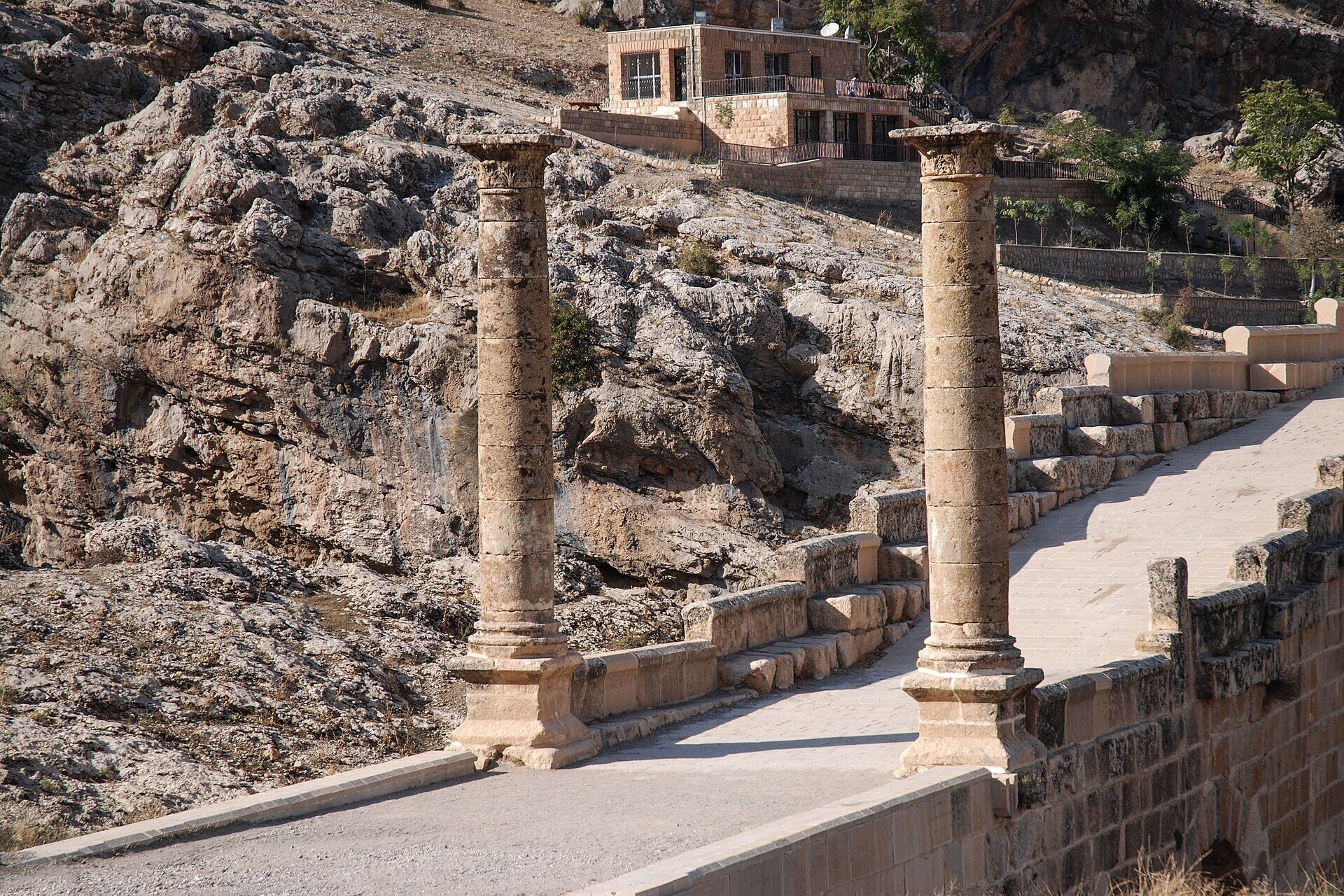
Current status: Cendere Bridge (also known in English as the Severan Bridge) withstood the February 2023 earthquakes intact and is open to visitors year-round. Closed to motor vehicles since its 1997 restoration, when a modern highway bridge was built nearby, the ancient span is open only to pedestrians. It is an open roadside monument with no ticket gate, so admission is free at any hour and Museum Pass Turkiye is not required.
The bridge spans the Cendere River (ancient Chabinas Creek) at the mouth of a narrow limestone canyon between the Kahta and Sincik districts, directly on the main tourist road linking Karakus Tumulus with Kocahisar village and Mount Nemrut. Because public buses do not serve this sightseeing route regularly, travelers arrive by rental car, private tour, or taxi from Kahta or Adıyaman. A roadside parking area sits a short walk from the southern ramp, with small seasonal cafes nearby. Plan for 20 to 30 minutes to walk across the stepped stone deck and view the arch from the riverbank below. Note that the stone surface slopes steeply and can be slippery when wet, so wear shoes with good traction.
Built between AD 198 and 200 by the 16th Roman Legion (Legio XVI Flavia Firma), which was garrisoned at Samosata, the bridge replaced an earlier crossing on the military highway toward Melitene. Latin inscriptions on the stone parapets record that four cities of Commagene jointly funded its construction in honor of Roman Emperor Septimius Severus and his family.
Cendere Bridge sits right in the middle of the Kahta valley sightseeing corridor, making it an effortless stop on any trip to Mount Nemrut. Coming from Kahta town, your stop immediately before the bridge is Karakus Tumulus, the royal burial mound from which Roman soldiers of the 16th Legion quarried stone blocks when building the bridge in the late 2nd century AD.
After walking across Cendere Bridge, follow the winding road north along the river valley to Kocahisar village. On the left side of the canyon rises Kahta and Kahta Castle (Yeni Kale), a restored Mamluk cliff fortress with secret water tunnels, while the opposite hillside holds Arsameia Ancient City, where Commagene reliefs and a 158-meter rock tunnel overlook the gorge. Together, these four stops trace the transition from Commagene royal rule to Roman and medieval times.
| Place | Type | Time needed | Best for | Entry |
|---|---|---|---|---|
| Cendere Bridge | Roman single-arch stone bridge | 20-30 mins | Mortarless Roman engineering and canyon views | Free |
| Karakus Tumulus | Royal Commagene burial mound | 20-30 mins | Eagle column and source of stones used in bridge | Free |
| Kahta and Kahta Castle | Medieval and ancient cliff castle | 45-60 mins | Fortress architecture and river gorge views | Free |
| Arsameia Ancient City | Commagene summer capital | 45-60 mins | Heracles handshake stele and Greek inscription | Free |
| Mount Nemrut | UNESCO summit sanctuary | 2-3 hours | Colossal royal statues at sunrise or sunset | Ticket |
The bridge originally had four Corinthian columns honoring Roman Emperor Septimius Severus, his wife Julia Domna, and their two sons, Caracalla and Geta. After Septimius Severus died, Caracalla had his brother Geta murdered and ordered his memory erased across the empire, so soldiers removed Geta's column from the northern entrance.
No, Cendere Bridge was closed to all vehicular traffic after its 1997 restoration, and a modern road bridge was built downstream to carry cars and tour buses. Today, you can walk across the ancient stone deck on foot without any traffic.
No, Cendere Bridge is an open historical monument with free admission 24 hours a day. You do not need a ticket or Museum Pass to walk across the bridge or explore the canyon banks.
Yes, built from interlocking dry-stone limestone blocks between AD 198 and 200, Cendere Bridge withstood the February 2023 earthquakes without structural collapse. It remains open to pedestrians.
Most visitors spend 20 to 30 minutes here. That gives you plenty of time to walk up and over the 120-meter bridge, inspect the Latin inscriptions on the columns, and walk down to the riverbank for photos of the arch framing the limestone canyon.
When the 16th Roman Legion built the bridge around AD 200, they took dressed stones from the nearby Karakus Tumulus, and the four cities of Commagene, including Perre, paid for the construction. Visiting all three sites lets you see how Roman rule reshaped the earlier Commagene kingdom.
Sources: en.wikipedia.org, tr.wikipedia.org, adiyaman.ktb.gov.tr, kulturportali.gov.tr
Last reviewed: